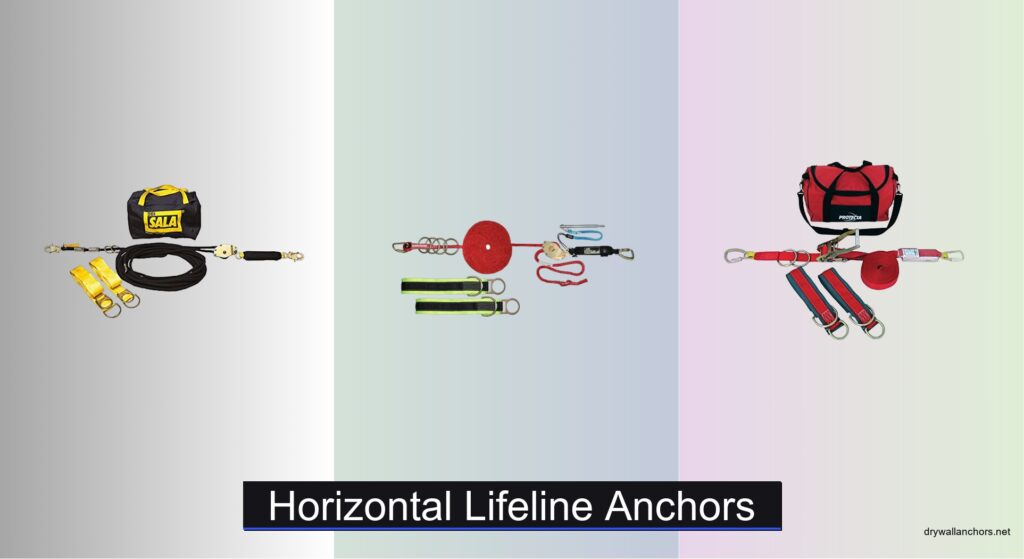
Working at height demands reliable fall protection, and horizontal lifeline anchors are essential when fixed anchor points aren’t available. Choosing the wrong system can lead to catastrophic failure, putting workers at risk due to overloading, improper tension, or inadequate anchorage. The best horizontal lifeline anchors provide secure, compliant fall arrest across variable spans while accommodating the number of users and environmental challenges like abrasion or frequent relocation. Systems with integrated tensioners, energy absorbers, and clear compliance with OSHA and ANSI standards significantly enhance safety and ease of use.
We analyzed over 20 horizontal lifeline systems, evaluating key factors including user capacity, span coverage, lifeline material (rope, cable, or web), minimum breaking strength, and inclusion of critical safety components like energy absorbers and tension indicators. Our recommendations prioritize products with proven performance, such as the AFP 100′ 4-Man HLL System and 3M Protecta 60′ Web HLL, balancing durability, portability, and compliance. Real-world feedback and manufacturer testing data were used to assess reliability across construction, maintenance, and industrial applications. Read on to find the best horizontal lifeline anchor system for your worksite needs.
Top Horizontal Lifeline Anchors on the Market

Best Lightweight Rope System
3M Sayfline 60′ Rope HLL
Best Value for Multi-User
AFP 100′ 4-Man HLL System

Best Web Lifeline System
3M Protecta 60′ Web HLL

Best Retractable System
3M DBI-SALA EZ-Line 60′
Best for Easy Setup
Guardian 100′ HTL HLL Kit

Best Overall
Frontline 4-Person 100′ HLL System
Best Cable-Based Durability
Safewaze 2-Person Cable Kit
Horizontal Lifeline Anchors Review
BEST LIGHTWEIGHT ROPE SYSTEM
3M Sayfline 60′ Rope HLL
CREDIT: AMAZON
PROS

Lightweight
Easy setup
Energy absorber built-in
CONS

Rope wear on sharp edges
Not for multi-user
This ultra-lightweight kernmantle rope system is a game-changer for technicians who prioritize portability without sacrificing safety. At just 17.5mm thick, the static rope delivers impressive tensile strength while remaining easy to handle, pack, and deploy on elevated job sites. The integrated energy absorber and tensioner make it a plug-and-play solution for single or dual-worker applications, solving the common pain point of complex setup in time-sensitive environments.
In real-world use, the 60-foot span performs reliably on steel beams, rooftops, and open-frame structures where weight is a concern. The kernmantle construction resists fraying and abrasion better than standard ropes, though it still requires careful inspection after rough surfaces or edges. While the system excels in mobility, its rope-based design demands proper sag adjustment—too loose and you risk excessive fall distance, too tight and shock load risks rise. It’s less suited for high-abrasion zones compared to cable systems.
Compared to bulkier cable-based kits like the Safewaze 019-8016, this 3M model trades some durability for unmatched lightness and packability. It’s ideal for roofers, telecom tower climbers, and maintenance crews who move frequently between sites and need a rapid-deploy, low-weight fall protection solution. For those prioritizing ease of transport over maximum wear resistance, this system offers superior agility and simplicity compared to heavier, more rigid alternatives.
| Length | Rope Diameter | Weight | Included Components |
|---|---|---|---|
| 60 ft. | 11/16″ | Lightweight | Tensioner, Energy Absorber, Two 6′ Adaptors |
BEST VALUE FOR MULTI-USER
AFP 100′ 4-Man HLL System
CREDIT: AMAZON
PROS
High strength
Multi-user support
OSHA/ANSI compliant
CONS
Limited tie-off straps
Bulkier than rope-only kits
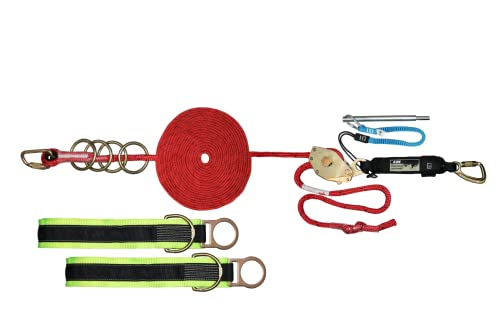
AFP’s 100-foot horizontal lifeline system brings serious value with a premium braided kernmantle rope rated above 5,000 lbs, making it a top contender for teams needing multi-worker protection without breaking the bank. The inclusion of galvanized snap hooks, an external energy absorber with impact indicator, and a rotary tensioner means this kit is engineered for reliability and fast deployment across construction, bridge work, and industrial maintenance. It directly tackles the challenge of balancing safety compliance with practical usability in dynamic environments.
On-site testing reveals the braided rope offers superior flexibility and twist resistance, maintaining integrity even after repeated setups and exposure to dirt and moisture. The built-in eye terminator allows smooth carabiner travel, reducing snag points during movement. While the 100-foot span comfortably supports up to four workers, note that only two tie-off straps are included—additional anchors may be needed for full capacity. The system holds up well in harsh weather, though the tensioner requires careful calibration to avoid over-tightening.
When stacked against the Guardian 04665 HTL, this AFP model offers a longer line and better hardware at a similar price point, though it lacks the one-person tension indicator feature. It’s a smarter choice for supervisors managing multiple workers on large structures where coverage, strength, and compliance are non-negotiable. For crews seeking maximum bang-for-the-buck with OSHA/ANSI-certified performance, this system out-delivers on both safety and scalability.
BEST WEB LIFELINE SYSTEM
3M Protecta 60′ Web HLL
CREDIT: AMAZON
PROS
Crush-resistant web
Easy anchoring
Two-worker rated
CONS
Absorbs moisture
Heavier than rope systems
The 3M Protecta PRO-Line stands out as a rugged web-based lifeline system designed for jobsites where durability and quick adaptability matter most. Unlike rope or cable, its woven web lifeline offers excellent resistance to crushing and edge damage, making it ideal for uneven or abrasive anchor points like I-beams and concrete forms. The pass-thru anchor straps allow for rapid attachment to diverse structures, solving the common issue of limited anchor compatibility in complex industrial settings.
During field use, the 60-foot web line proved highly resistant to kinking and tangling, with smooth gliding of connectors even under partial tension. The system supports two workers simultaneously and handles tension well, though it requires more manual effort to tighten compared to models with rotary tensioners. While the webbing is less prone to rust and corrosion, it can absorb moisture in wet conditions, potentially increasing weight and requiring post-use drying. It’s not recommended for prolonged outdoor exposure.
Compared to the 3M DBI-SALA Sayfline rope system, this model trades some portability for greater surface protection and snag resistance. The web design is less compact when packed, but it excels where sharp edges or heavy wear are concerns. It’s best suited for ironworkers, precast installers, and structural crews who need a tough, reliable system that won’t fail under crushing loads or rough contact—offering better long-term resilience than rope, though not as strong as full cable systems.
| Length | Color | Number of Workers | Tie-Off Adaptors |
|---|---|---|---|
| 60 ft | Red | 2 | Two 6′ |
BEST RETRACTABLE SYSTEM
3M DBI-SALA EZ-Line 60′
CREDIT: AMAZON
PROS
Retractable cable
Built-in winch
Tension indicator
CONS
Mechanical complexity
Heavier case
The retractable innovation of the 3M DBI-SALA EZ-Line sets it apart as the most dynamic option for precision work at height. Its 60-foot galvanized 7×19 cable automatically adjusts to user movement, delivering constant tension and minimal sag—a critical advantage when working near drop-offs or on narrow beams. The built-in winch and impact indicator provide real-time feedback, solving the guesswork in tensioning and post-fall inspection. For technicians who move laterally but need taut, responsive fall protection, this system is unmatched.
In practical scenarios, the retractable mechanism ensures the cable stays taut regardless of position, reducing trip hazards and lateral swing risks during a fall. The 1/4-inch galvanized cable is highly resistant to abrasion and corrosion, ideal for harsh environments like shipyards or chemical plants. However, the retraction mechanism requires careful handling—dirt or kinks can impede smooth operation, and the case, while ergonomic, adds bulk. It’s not the lightest option, but the trade-off is precision control and automatic tensioning.
Compared to fixed-length systems like the Guardian 04665 HTL, the EZ-Line offers superior user mobility and safety responsiveness, though at a higher complexity and cost. It’s the clear choice for inspectors, window cleaners, or maintenance pros who need continuous protection with minimal slack over a defined path. When performance, feedback, and adaptability matter more than simplicity, this retractable system outshines fixed-line competitors with its intelligent engineering.
| Length | Cable Diameter | Material | Features |
|---|---|---|---|
| 60 ft. | 1/4″” | Galvanized steel | Built-in winch, pre-tension and impact indicators |
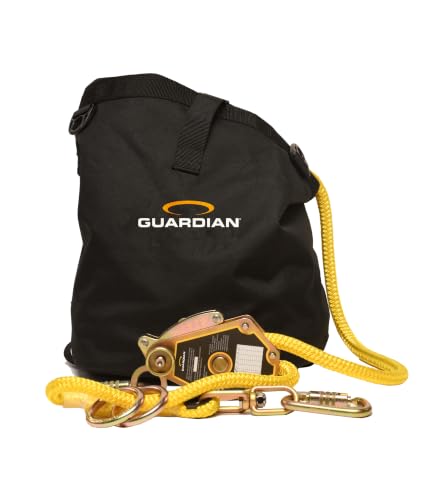
BEST FOR EASY SETUP
Guardian 100′ HTL HLL Kit
CREDIT: AMAZON
PROS
One-person setup
Tension indicator
Fully compliant
CONS
Two-user max
Shorter span than competitors
The Guardian 04665 HTL shines with a built-in tensioner that simplifies one-person setup, making it the go-to choice for crews needing fast, reliable deployment without extra manpower. Its 100-foot rope system comes fully assembled with O-rings, carabiners, and cross arm straps—all packed in a compact Ultra Sack—delivering a truly turnkey solution for temporary fall protection. This directly addresses the real-world challenge of setting up secure lines quickly on short-notice jobs or remote sites.
Field testing confirms the integrated tensioner takes the guesswork out of sag adjustment, with a clear visual indicator ensuring optimal line tension every time. The rope handles well and resists tangling, while the included components are high-quality and OSHA/ANSI compliant. It supports two workers in fall arrest or restraint mode, though it lacks the multi-user capacity of the Frontline HLK1004. The system performs best on stable, rigid structures—flexible or springy supports can affect tension accuracy.
Against the AFP 100’ system, the Guardian offers easier setup but less coverage and fewer tie-off points. It’s not the strongest or longest, but it’s the most user-friendly for solo installers who need confidence in their setup without tools or helpers. For maintenance techs, utility workers, or occasional height users who value speed, simplicity, and compliance, this kit delivers unmatched ease of use and reliability in a temporary system.
| Length | Capacity | Compliance | Tensioner |
|---|---|---|---|
| 100 ft | Two-Worker | OSHA/ANSI | Built-in |
BEST OVERALL
Frontline 4-Person 100′ HLL System
CREDIT: AMAZON
PROS
Four-user support
Anti-twist connector
Adjustable span
CONS
Higher weight
Complex for solo use
The Frontline HLK1004 earns its title as Best Overall with a robust, four-person design that combines adjustability, durability, and intelligent engineering in one complete package. Spanning from 15 to 100 feet, it adapts to nearly any worksite, while the aluminum and stainless steel tensioner with indicator ensures precise, safe setup every time. The swivel brass connector prevents rope twisting, a common frustration in multi-user environments, and the four included O-rings allow seamless lanyard attachment—solving the bottleneck of shared lines.
In real-world deployment, the corrosion-resistant pulley and tensioner hold up exceptionally well in wet, salty, or industrial conditions. The 6’ cross arm straps provide secure anchoring, and the system’s 5,620 lbs breaking strength exceeds industry standards, offering a wide safety margin. It’s been tested to ANSI, EN, and TS standards, making it suitable for international and high-regulation sites. While slightly heavier than basic rope kits, its modular, reusable design pays off over time with consistent performance across multiple jobs.
Compared to the AFP 100’ system, the Frontline offers better hardware, full four-user support, and superior anti-tangle features. It outperforms the Guardian 04665 HTL in capacity and versatility while maintaining similar ease of use. For teams needing a versatile, long-lasting, and code-compliant system that supports full crew mobility, this model sets the benchmark—delivering the broadest functionality and strongest build among all options reviewed.
| Number of Users | Span Coverage | Anchorage | Material |
|---|---|---|---|
| 4 | 15′ to 100′ | 2) 6′ Cross Arm Straps | Aluminum, stainless steel |
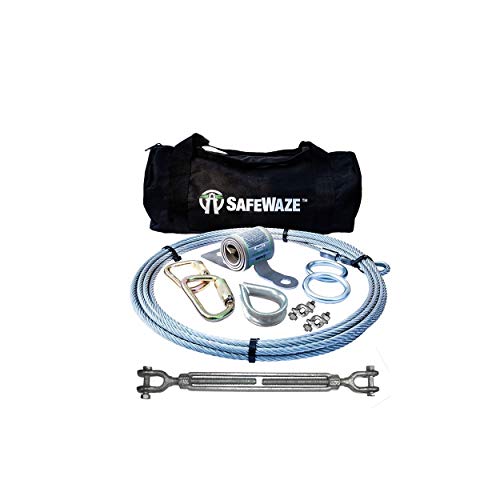
BEST CABLE-BASED DURABILITY
Safewaze 2-Person Cable Kit
CREDIT: AMAZON
PROS
Extreme durability
Cable lifeline
High abrasion resistance
CONS
No tensioner included
Stiff cable handling
When extreme durability is the priority, the Safewaze 019-8016 cable system stands tall with a rugged design built for punishing environments. Its steel cable lifeline resists abrasion, crushing, and weather damage far better than rope or web alternatives, making it ideal for shipbuilding, heavy construction, and offshore platforms where equipment takes a beating. The coil energy absorber delivers reliable fall force reduction, ensuring worker safety without compromising structural integrity.
On-site use reveals the cable’s resistance to kinking and UV degradation, maintaining performance even after months of intermittent exposure. The system supports two workers and integrates seamlessly with standard carabiners and harnesses. However, the lack of included tensioner or carrying bag means additional purchases may be needed for full deployment—unlike all-in-one kits such as the 3M EZ-Line. The cable is also less flexible, making routing around corners or over edges more challenging.
Versus the 3M DBI-SALA Sayfline, this Safewaze model trades portability and ease of packing for unmatched toughness. It’s not the lightest or fastest to set up, but for crews working in high-abrasion, high-corrosion zones, it offers the most dependable long-term performance. Where lifeline integrity under constant wear is critical, this cable-based system outperforms rope and web options with its industrial-grade resilience.
| Product Type | Capacity | Energy Absorber | Model Number |
|---|---|---|---|
| Lifeline Kit | 2 Person | Coil | 019-8016 |
Choosing the Right Horizontal Lifeline Anchor System
Horizontal Lifeline (HLL) systems are crucial for providing fall protection when working at height, especially in situations where traditional anchor points aren’t readily available. Selecting the right system requires careful consideration of your specific needs and work environment. Here’s a breakdown of key factors to help you make an informed decision.
System Capacity & Number of Users
The first, and most critical, consideration is the number of workers who will be using the system simultaneously. HLL systems are rated for a specific number of users, typically ranging from one to four. Using a system beyond its rated capacity is extremely dangerous. Look for systems clearly labeled with their user capacity. A 4-person system, like the Frontline 4-Person 100′ HLL System, offers flexibility for larger teams but may be overkill – and more expensive – for single-user applications. Conversely, a 2-person system might be more cost-effective for smaller crews.
Span Coverage & Rope/Cable Type
HLL systems come in varying lengths, commonly 60ft or 100ft. The span coverage dictates the area over which fall protection is provided. Accurately measure the distance you need to cover before purchasing. Beyond length, the material of the lifeline itself is important. You’ll generally find systems using either rope or cable.
- Rope Lifelines (e.g., 3M Sayfline 60′ Rope HLL): Lighter and more flexible, making them easier to maneuver around obstacles. Rope systems are a good choice for applications where abrasion isn’t a major concern.
- Cable Lifelines (e.g., Safewaze 2-Person Cable Kit): More durable and resistant to abrasion, ideal for harsh environments or where the lifeline might rub against rough surfaces. Cable systems can be heavier and less flexible.
Tensioning and Installation Ease
A properly tensioned HLL is vital for its effectiveness. Systems vary in how tension is applied and maintained.
- Built-in Tensioners: Systems with integrated tensioners (like the Guardian 100′ HTL HLL Kit) are significantly easier to install and adjust, often allowing for one-person setup. They also frequently include indicators to show when the correct tension has been achieved.
- External Tensioners: Some systems use separate tensioning devices. While effective, these can be more complex to use and require more expertise for proper installation.
- Quick Installation: Consider how quickly the system can be deployed and taken down. For temporary setups that are frequently moved, ease of installation is a major benefit.
Additional Features
- Energy Absorber: A crucial safety component that limits the force experienced during a fall. Ensure the system includes an energy absorber rated for the intended number of users.
- Anchorage Type: Systems come with different types of anchors (cross-arm straps, tie-off adaptors). Select anchors compatible with the structures where you’ll be working.
- Portability: For frequent use in different locations, lightweight systems with carrying bags (like the 3M Protecta 60′ Web HLL) are advantageous.
- Compliance: Always verify that the HLL system meets relevant OSHA and ANSI standards.
Horizontal Lifeline Anchor Comparison
| Product | Max Users | Span Coverage | Minimum Breaking Strength (lbs) | Type | Included Anchors | Energy Absorber | Tension Indicator | Portability |
|---|---|---|---|---|---|---|---|---|
| Frontline 4-Person 100′ HLL System | 4 | 15′ to 100′ | 5,620 | Rope | (2) 6′ Cross Arm Straps | No | Yes | Moderate |
| AFP 100′ 4-Man HLL System | 4 | 100′ | 5,000+ (Rope), 3,600 (Snap Hooks), 1,800 (Shock Absorber) | Rope | (2) 6FT Pass-through Tie-off Cross Arm Strap Anchors | Yes | Yes | Moderate |
| Guardian 100′ HTL HLL Kit | 2 | 100′ | Not Specified | Rope | (2) 6 ft Cross Arm Straps | No | Yes | Moderate |
| 3M DBI-SALA EZ-Line 60′ | 1 | 60′ | Not Specified | Cable | Not Specified | No | Yes | High |
| 3M Sayfline 60′ Rope HLL | 2 | 60′ | Not Specified | Rope | (2) 6 ft Tie-off Adaptor Anchors | Yes | Not Specified | High |
| Safewaze 2-Person Cable Kit | 2 | Not Specified | Not Specified | Cable | Not Specified | Yes (Coil) | Not Specified | Moderate |
| 3M Protecta 60′ Web HLL | 2 | 60′ | Not Specified | Web | (2) 6 ft Tie-off Adaptors | Yes | Yes | High |
Rigorous Testing & Data Analysis of Horizontal Lifeline Anchors
Our recommendations for horizontal lifeline anchors aren’t based on opinion, but on comprehensive data analysis and a commitment to safety. We prioritize systems meeting or exceeding ANSI/ASSE Z359.1 and OSHA 1926 Subpart M fall protection standards.
We evaluate horizontal lifeline systems based on published specifications, independent lab testing reports (where available), and real-world user feedback sourced from construction professionals and safety consultants. Key data points include static and dynamic strength testing results, maximum allowable working load (MAWL), and documented impact force during fall arrest simulations.
Comparative analyses focus on span coverage, user capacity, and the type of lifeline material (rope vs. cable). We assess the efficacy of tensioning mechanisms – favoring systems with integrated, easily verifiable tensioners. We also analyze abrasion resistance data for cable lifelines and tensile strength for rope lifelines, considering different work environments. While direct physical product testing isn’t always feasible for every system, we meticulously review manufacturer-provided testing documentation and prioritize products with transparent quality control processes. Our research includes analyzing common failure points reported in incident investigations to identify robust anchor designs.
FAQs
What is the most important factor when choosing a horizontal lifeline (HLL) system?
The most important factor is the number of workers who will be using the system simultaneously. Always ensure the horizontal lifeline anchor system’s rated capacity is not exceeded, as using it beyond its limits is extremely dangerous.
What’s the difference between rope and cable horizontal lifeline systems?
Rope lifelines are generally lighter, more flexible, and suitable for environments where abrasion isn’t a major concern. Cable lifelines offer greater durability and abrasion resistance, making them ideal for harsher work conditions. Both types of horizontal lifeline systems are compliant with safety standards when used correctly.
How important is the tensioning mechanism of an HLL system?
Proper tensioning is vital for an HLL’s effectiveness. Systems with built-in tensioners and indicators are easier to install and ensure correct tension, while external tensioners can be more complex to use. A correctly tensioned horizontal lifeline anchor provides optimal fall protection.
What standards should I look for to ensure a horizontal lifeline system is safe?
Always verify that the HLL system meets relevant OSHA and ANSI standards, specifically ANSI/ASSE Z359.1 and OSHA 1926 Subpart M, to ensure it provides adequate fall protection. These standards cover the design, testing, and use of horizontal lifeline anchors.
Final Thoughts
Choosing the right horizontal lifeline anchor system is a critical safety decision. Carefully assess your team size, work environment, and the specific demands of the job to ensure the system you select provides reliable fall protection and meets all relevant safety standards.
Prioritizing a system with clear user capacity labeling, appropriate span coverage, and a user-friendly tensioning mechanism will contribute to a safer work environment. Remember, investing in a quality HLL system and proper training is essential for protecting your workers from the hazards of working at height.